Glutathione injections have become popular in wellness, skin health, and antioxidant therapy conversations, but the science is more nuanced than social media often makes it seem.
In this guide, we will look at what glutathione is, why people consider injections, the potential benefits supported by research, and the safety concerns to discuss with a medical provider.
Glutathione is a natural antioxidant made inside the body. It is composed of three amino acids: glutamine, glycine, and cysteine.
The body uses glutathione to help manage oxidative stress, support cellular repair, assist detoxification pathways, and protect tissues from free-radical damage.
Glutathione has real biological importance, but that does not mean everyone needs injections. Injectable use should be approached carefully, with realistic expectations and appropriate medical supervision.
Considering Glutathione or Antioxidant Therapy?
Review your wellness goals, health history, possible benefits, and safety concerns with a qualified medical provider.
What Are Glutathione Injections?
Glutathione injections deliver glutathione directly into the body through an injection or infusion. Some wellness clinics use them as part of antioxidant support, IV therapy, or skin-focused treatment plans.
People often ask about glutathione because it plays a role in cellular defense. It helps neutralize reactive molecules that can damage cells when oxidative stress becomes too high.
Oxidative stress is not always harmful. The body uses oxidation during normal immune and metabolic processes. Problems may develop when oxidative stress overwhelms the body’s antioxidant systems.
Glutathione Is Naturally Produced by the Body
Injected glutathione is not introducing a completely foreign substance. However, the route, dose, product quality, sterility, and reason for treatment still affect the potential risks and benefits.
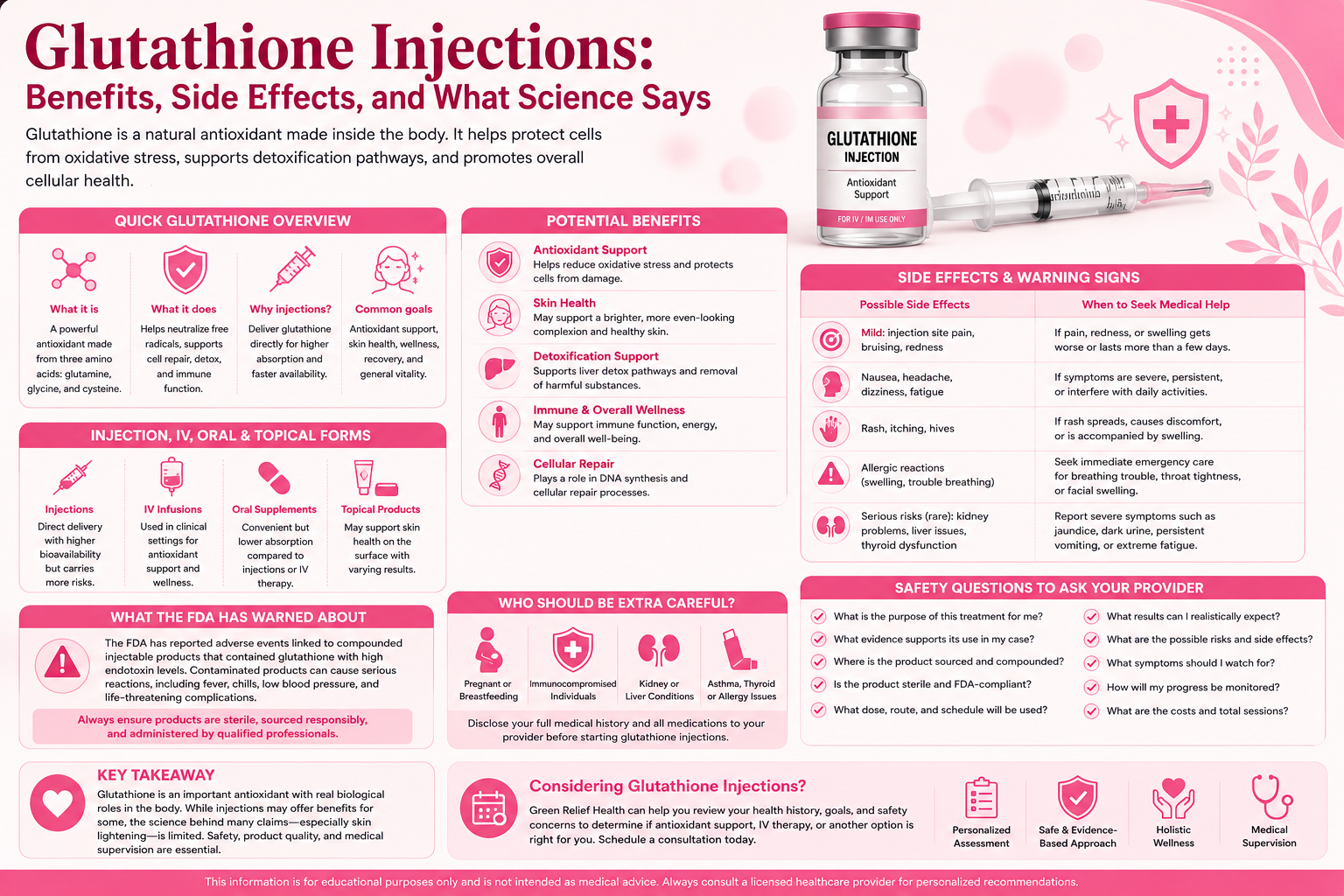
Quick Glutathione Overview
This overview matters because glutathione is biologically important, but not every advertised benefit is equally supported by research.
What It Is
A naturally produced antioxidant composed of glutamine, glycine, and cysteine.
What It Does
Helps support cellular defense, redox balance, detoxification pathways, and tissue protection.
How It Is Given
It may be offered through an injection or IV infusion in some wellness settings.
What Is Uncertain
The effectiveness and safety of many cosmetic and general wellness claims remain unclear.
Why People Consider Glutathione Injections
People usually ask about glutathione injections for three broad reasons: antioxidant support, skin brightening, or help with general wellness and recovery.
Glutathione also appears in conversations about liver support, immune health, aging, inflammation, and detoxification.
1
Antioxidant and cellular support
2
Skin-brightening or pigmentation goals
3
General wellness and recovery support
Popular Claims May Exceed the Evidence
The strongest science supports glutathione’s role inside the body. The clinical benefit of injections depends on the reason for use, and many broad wellness claims have not been proven conclusively.
Potential Benefits of Glutathione
Glutathione is often called a “master antioxidant” because it works inside cells and helps recycle other antioxidants. A more precise description is that glutathione participates in several important biological processes.
Research reviews describe glutathione as being involved in redox balance, oxidative stress reduction, metabolic detoxification, and immune system regulation.
Some studies have explored glutathione in conditions involving oxidative stress, metabolic health, liver health, and vascular function. Results vary by population, dose, route, and study design.
→ Cellular antioxidant defense Glutathione helps neutralize reactive molecules and supports the body’s internal antioxidant systems.
→ Redox balance It contributes to the balance between oxidation and antioxidant activity inside cells.
→ Metabolic detoxification Glutathione participates in pathways the body uses to process and remove certain compounds.
→ Immune regulation It plays a role in normal immune activity and cellular communication.
It is better to discuss potential benefit areas than guaranteed outcomes. A biological role inside the body does not automatically prove that injections will produce a meaningful clinical benefit for every person.
Glutathione and Skin Brightening
Skin brightening is one of the most talked-about uses of glutathione injections. The proposed idea is that glutathione may influence melanin pathways and shift pigment production.
However, the evidence supporting IV or injectable glutathione for skin lightening is limited. Reviews have raised concerns because long-term safety and effectiveness are not well established.
Some oral and topical studies have shown modest or temporary effects on skin tone, but this does not prove that injections are safe or effective for cosmetic lightening.
Be Cautious With Dramatic Whitening Claims
Clinics should not promise permanent skin-color change, guaranteed whitening, or dramatic cosmetic results. Strong marketing claims are not the same as strong scientific evidence.
Injection, IV, Oral, and Topical Forms
Glutathione is available or discussed in several forms, including injections, IV infusions, oral supplements, sublingual products, and topical products.
Each route raises different questions about absorption, safety, convenience, product quality, and supporting evidence.
| Form | How It Is Used | Main Considerations |
|---|---|---|
| Injection | Delivered directly through an injection | Requires sterile products, proper technique, and medical supervision |
| IV infusion | Delivered into a vein during an infusion | Bypasses digestion but carries risks related to sterility, dosing, and administration |
| Oral | Taken as a capsule, tablet, or liquid | Absorption and effectiveness may vary by product and individual |
| Sublingual | Placed under the tongue | Marketed as an alternative to standard oral use, but evidence varies |
| Topical | Applied to the skin | Often marketed for cosmetic use; effects may be modest or temporary |
Bypassing Digestion Does Not Eliminate Risk
Injection and IV routes may deliver a substance directly into the body, but they also create additional concerns when products are contaminated, improperly compounded, or administered by an unqualified person.
Side Effects of Glutathione Injections
Glutathione injections may cause side effects. Risk may increase when products are poorly compounded, improperly administered, or used without medical supervision.
Possible side effects may include injection-site pain, bruising, rash, nausea, headache, dizziness, abdominal discomfort, and allergic reactions.
| Reaction Type | Possible Symptoms | Recommended Response |
|---|---|---|
| Local injection reaction | Pain, soreness, tenderness, redness, or bruising | Monitor the area and contact the provider if symptoms worsen or persist |
| Mild general reaction | Nausea, headache, dizziness, or abdominal discomfort | Notify the treating provider, especially if symptoms are persistent |
| Skin reaction | Rash, itching, or widespread skin changes | Stop and seek medical guidance, particularly if the reaction is spreading |
| Serious allergic reaction | Facial swelling, throat tightness, breathing difficulty, or severe hives | Seek urgent medical care |
| Possible systemic complication | Severe weakness, fever, chills, low blood pressure, or other unusual symptoms | Seek prompt medical evaluation |
More serious concerns have been reported in connection with unregulated or unsafe injectable use, including severe allergic reactions, kidney problems, liver concerns, thyroid dysfunction, and serious skin reactions in some reports.
Know the Emergency Warning Signs
Breathing difficulty, throat tightness, facial swelling, a severe or rapidly spreading rash, faintness, or other whole-body symptoms should never be ignored.
Risk Is Not Only About the Glutathione Molecule
Product quality, sterility, dose, additives, storage, handling, and the skill of the person administering the injection may all affect safety.
What the FDA Has Warned About
The FDA has raised concerns about compounded sterile injectable products containing glutathione when product-quality problems are present.
In 2019, the FDA reported adverse events involving seven patients who received an injectable drug compounded with L-glutathione that may have contained high endotoxin levels.
Endotoxins can cause serious health effects, including fever, chills, low blood pressure, and potentially life-threatening reactions.
Sterile Injectable Quality Is Critical
This warning does not mean every glutathione treatment is contaminated. It does show why patients should avoid cheap, unverified, or non-medical injection services.
The source and handling of injectable products matter. Medical supervision should include appropriate sourcing, sterile preparation, proper storage, and safe administration.
Who Should Be Extra Careful?
Some people should be especially cautious before considering glutathione injections.
Discuss Treatment Carefully if You Are:
- Pregnant or breastfeeding
- Immunocompromised
- Managing kidney or liver concerns
- Living with asthma or thyroid concerns
- Prone to allergies or severe drug reactions
- Managing a history of unexplained or serious rashes
- Taking medications, supplements, or receiving other injections
Medication and supplement interactions are not always obvious. A responsible provider should review your full health history before offering injectable wellness treatment.
What Science Says About Antioxidant Therapy
The science around antioxidant therapy is not as simple as “more antioxidants equals better health.” The body needs balance.
Free radicals and oxidative signals participate in immune defense, exercise adaptation, and normal cell communication. Excessive oxidative stress can be harmful, but excessive antioxidant intervention may not always be beneficial either.
→ Oxidation is not always harmful. Normal oxidation plays a role in metabolism, immune function, and cellular signaling.
→ More is not automatically better. A higher antioxidant dose does not guarantee a greater health benefit.
→ The reason for treatment matters. Evidence should be considered in relation to the specific goal, route, dose, and patient.
→ Personalization matters. Medical history, medications, symptoms, and risk factors can change the benefit-risk discussion.
Aim for Appropriate Support, Not the Highest Dose
A thoughtful wellness plan considers nutrition, sleep, movement, medical conditions, and other treatments before deciding whether an injectable antioxidant is necessary.
How to Talk With a Provider Before Treatment
A provider should explain why glutathione is being considered, the evidence supporting that use, possible side effects, and realistic expectations.
The best conversation should honestly cover both potential benefits and known uncertainties.
| Safety Question | Why It Matters |
|---|---|
| Why are you recommending glutathione for me? | The treatment should have a clear goal rather than being offered as a universal wellness solution. |
| What evidence supports this use? | Research strength varies depending on the condition, route, and intended outcome. |
| Where does the product come from? | Sourcing and compounding quality affect the safety of sterile injectable products. |
| How is sterility maintained? | Contamination can cause severe whole-body reactions. |
| What dose and route will be used? | Potential effects and risks may vary by dose and method of administration. |
| How many sessions are recommended? | The treatment plan should include a clear rationale and follow-up process. |
| What side effects should prompt a call? | Patients should know how to distinguish a mild local reaction from a serious reaction. |
| What results are realistic? | A responsible provider should not promise guaranteed whitening, detoxification cures, or disease treatment without strong evidence. |
These questions are not meant to complicate treatment. They help patients make safer decisions and identify providers who communicate honestly about evidence, quality, and risk.
Are Glutathione Injections Worth It?
The answer depends on why you are considering them.
| Primary Goal | Important Considerations |
|---|---|
| General antioxidant support | The discussion should include nutrition, sleep, lifestyle, medical history, and whether injection therapy is truly necessary. |
| Skin lightening | The evidence for injections is insufficient to support bold claims, and safety concerns remain important. |
| Wellness support | A medical provider can help determine whether glutathione fits within a broader, individualized wellness plan. |
| Disease treatment | Patients should be cautious when glutathione is promoted as a cure or substitute for evidence-based medical care. |
There Is No Universal Answer
The potential benefits, limitations, and risks change from person to person. Treatment should be based on a clear goal, realistic expectations, and medical judgment.
Discuss Glutathione With a Medical Provider
Green Relief Health can help you review your goals, health history, treatment options, and safety questions before moving forward.
Final Thoughts
Glutathione is an important antioxidant that the body naturally produces. It plays a real role in cellular defense, oxidative stress balance, and detoxification pathways.
Glutathione injections are popular, but the evidence supporting many cosmetic and general wellness claims remains limited. Skin-lightening claims, in particular, should be approached cautiously.
Side effects can range from mild injection-site soreness to serious reactions when products are contaminated, unsafe, or poorly administered.
The safest approach combines medical supervision, realistic expectations, reliable product quality, and a clear understanding of what science does and does not yet prove.
Explore Safe, Medically Supervised Wellness Options
Discuss whether glutathione, IV therapy, or another wellness approach is appropriate for your individual needs.
📍 7690 Belair Road, Suite 1, Baltimore, MD 21236 | 📞 410-368-0420
Frequently Asked Questions
What is glutathione?
Glutathione is a naturally produced antioxidant made from glutamine, glycine, and cysteine. It participates in cellular defense, redox balance, detoxification pathways, and immune regulation.
Do glutathione injections lighten the skin?
Glutathione may influence pathways involved in pigment production, but evidence supporting injectable or IV glutathione for skin lightening is limited. Long-term safety and effectiveness have not been well established.
What are the possible side effects of glutathione injections?
Possible side effects include injection-site pain, bruising, rash, nausea, headache, dizziness, abdominal discomfort, and allergic reactions. Serious reactions may occur when products are contaminated, poorly compounded, or improperly administered.
Are glutathione injections FDA-approved for skin whitening?
The supplied evidence does not support treating injectable glutathione as a proven skin-whitening therapy. Patients should be cautious with providers who promise dramatic or permanent cosmetic lightening.
Who should be cautious about glutathione injections?
People who are pregnant, breastfeeding, immunocompromised, managing kidney or liver concerns, living with asthma or thyroid issues, or prone to allergies and severe drug reactions should discuss the risks carefully with a medical provider.
How can I evaluate whether a clinic is using glutathione safely?
Ask about product sourcing, sterile preparation, dose, route, additives, provider qualifications, possible side effects, emergency procedures, expected results, and follow-up. Avoid services that offer unverified products or guaranteed outcomes.
Medical Disclaimer
This article is for informational purposes only and is not medical advice. It does not establish that glutathione injections are appropriate, safe, or effective for any individual. Always consult a qualified healthcare professional before starting, stopping, or changing injections, infusions, supplements, medications, or any other treatment plan. Seek urgent medical care for breathing difficulty, throat tightness, facial swelling, faintness, or a severe or rapidly spreading rash.
↑