Updated July 2026 Evidence Reviewed Baltimore, MD
NAD+ and glutathione are naturally occurring molecules with important—but different—roles in human biology. NAD+ participates in energy-transfer reactions and serves as a substrate for enzymes involved in cellular signaling and DNA repair. Glutathione is a three-amino-acid antioxidant involved in redox balance and selected detoxification reactions.
Can NAD+ and glutathione be used together? They can be considered together after a qualified clinician reviews the person’s goals, medicines, health conditions, treatment route, and product source. Their biochemical systems are related, but strong human trials have not established that combined NAD+ and glutathione IV therapy produces superior energy, cognition, recovery, “detox,” anti-aging, or longevity outcomes compared with either treatment, oral approaches, or no treatment. Direct IV NAD+ evidence remains preliminary, and compounded sterile NAD+ and glutathione products have quality and adverse-event concerns.
Established cell biology should not be confused with proven wellness outcomes. A molecule can be essential inside the body without an infusion of that molecule being proven to improve symptoms in a healthy person.
This guide separates four different questions: what NAD+ and glutathione normally do, whether supplements change blood or cellular markers, whether those marker changes improve health outcomes, and whether combining the two adds a clinically meaningful benefit.
Considering NAD+ or Glutathione Therapy?
A consultation can review the symptom you want to address, more established explanations and treatments, product sourcing, route options, potential interactions, and whether an elective IV is a reasonable choice.
Book a Consultation Wellness treatment is not a substitute for diagnosis or emergency care
Essential Normal roles in cellular metabolism
Biomarkers Oral studies can raise measured levels
Preliminary Direct NAD+ IV human evidence
Unproven Superior outcomes from the IV combination
NAD+ vs Glutathione: What Is the Difference?
| Feature | NAD+ | Glutathione |
|---|---|---|
| What it is | A dinucleotide coenzyme present in every cell | A tripeptide made from glutamate, cysteine, and glycine |
| Main biochemical role | Accepts electrons in redox reactions and serves as a substrate for enzymes including PARPs and sirtuins | Participates in antioxidant defense, thiol redox balance, and glutathione-S-transferase conjugation reactions |
| Major paired form | NAD+/NADH | Reduced glutathione/oxidized glutathione (GSH/GSSG) |
| How the body makes or maintains it | From vitamin B3–related precursors, tryptophan, and cellular salvage pathways | From amino acids, with cysteine availability often limiting synthesis |
| What supplementation research most reliably shows | Some oral precursors can raise NAD-related blood metabolites | Some oral formulations can raise glutathione in selected body compartments |
| What is not established | That direct IV NAD+ reverses aging or reliably treats fatigue, brain fog, or cognitive decline | That elective IV glutathione “detoxes” healthy people, reverses aging, or produces durable clinical benefits |
NAD+ is not a peptide It is a coenzyme. Glutathione is a small peptide because it contains three linked amino acids. Marketing often groups NAD+, vitamins, peptides, and antioxidants together even though they are different categories.
How Are NAD+ and Glutathione Related?
The two systems are connected through cellular redox metabolism, but the relationship is often oversimplified in wellness advertising.
Established biology
NAD+/NADH Moves Electrons
The NAD+/NADH pair is central to glycolysis, the citric-acid cycle, and mitochondrial energy metabolism.
Established biology
GSH Helps Control Oxidative Stress
Glutathione peroxidases use GSH while neutralizing selected peroxides, converting it to GSSG.
Important correction
Glutathione Reductase Uses NADPH
The enzyme that converts GSSG back to GSH primarily uses NADPH—not NAD+ directly—as its reducing power.
Mechanistic link
Metabolic Pathways Interconnect
NAD+, NADP+, NADH, NADPH, and glutathione participate in overlapping metabolic networks, but that does not prove a specific IV “synergy” in patients.
Biochemical complementarity is a hypothesis for combination treatment—not proof that receiving both in an IV produces better clinical outcomes.
What Does the Evidence Actually Show?
Strongest evidence
Normal Biological Functions
NAD and glutathione systems are essential for life and are well characterized in biochemistry, physiology, and disease research.
Moderate but limited
Oral Biomarker Changes
Randomized human studies show that nicotinamide riboside can raise blood NAD-related levels and that oral glutathione can raise glutathione stores in selected compartments.
Early evidence
Direct NAD+ IV Tolerability
A small 2026 commercial-infusion study reported short-term tolerability data and variable exploratory metabolic outcomes, with more research needed beyond 30 days.
Not established
Combined Wellness Outcomes
Robust randomized trials have not shown that NAD+ plus glutathione IV reliably improves energy, cognition, athletic recovery, immune function, longevity, or toxin removal in generally healthy adults.
A higher blood level is not the same as a health benefit A trial can demonstrate absorption or a biomarker increase without proving that participants feel better, function better, avoid disease, or live longer.
NAD+: Biology, Oral Precursors, and IV Research
NAD exists mainly as NAD+ and NADH. It helps transfer electrons during energy metabolism and is consumed by signaling enzymes involved in DNA-damage responses, calcium signaling, inflammation, and circadian biology.
Do NAD Levels Decline With Age?
Age-related declines have been observed in multiple tissues and experimental models, but the amount varies by tissue, measurement method, health status, and study. A universal claim that everyone loses exactly 50% of NAD+ by age 50 is not supported by a single standard clinical measurement.
What Do Oral Precursor Trials Show?
In a randomized crossover trial of 24 healthy middle-aged and older adults, six weeks of nicotinamide riboside increased NAD-related blood measures and was generally well tolerated. The study did not prove broad anti-aging, cognitive, energy, or longevity outcomes.
What Do We Know About Direct NAD+ IV?
Human evidence for direct NAD+ infusion is much thinner than evidence for the molecule’s normal biology or oral precursor pharmacology. A 2026 study comparing commercially administered NAD+ IV and nicotinamide-riboside IV offered preliminary short-term safety and tolerability information. Exploratory biomarker findings were variable, and the authors called for additional studies on dose and effectiveness beyond 30 days.
Directly entering a vein does not guarantee entry into every cell IV administration places the administered dose into circulation, but “100% bioavailability” is often used misleadingly. It does not establish cellular uptake, tissue distribution, duration, target engagement, or clinical effectiveness.
Glutathione: Antioxidant Biology, Oral Research, and IV Concerns
Reduced glutathione (GSH) participates in antioxidant reactions, protein-thiol regulation, and selected detoxification pathways. In the liver, glutathione-S-transferases can attach glutathione to certain compounds, supporting their processing and elimination.
Does Oral Glutathione Work?
Oral absorption was once considered negligible, but research is mixed and formulation dependent. A six-month randomized trial of 54 healthy nonsmoking adults found that daily oral glutathione increased glutathione levels in several body compartments. The study showed a biomarker effect; it did not prove generalized detoxification, anti-aging, disease prevention, or superior exercise recovery.
What About IV Glutathione?
IV administration produces direct systemic exposure, but evidence for elective wellness benefits remains limited. Risks include IV complications, allergic reactions, dosing uncertainty, and quality problems when a compounded sterile ingredient is contaminated or unsuitable for injection.
FDA has documented serious reactions to compounded injectable glutathione In one investigation, patients developed nausea, vomiting, lightheadedness, chills, body aches, low blood pressure, breathing difficulty, fever, and shaking after products associated with excessive endotoxin exposure. Some required hospital care.
Can NAD+ and Glutathione Be Taken Together?
There is no general biochemical reason that every patient must avoid using them during the same treatment period. However, “can be considered together” is different from “should always be taken together for optimal results.”
Important Practical Questions
- What symptom or goal is being treated?
- Has a more common medical cause been evaluated?
- Is the route oral, intramuscular, subcutaneous, IV push, or IV infusion?
- Is the product FDA-approved, a dietary supplement, or a compounded drug?
- What human outcome data support the proposed protocol?
- What is the product source, lot, beyond-use date, and sterility-testing process?
- What adverse effects are expected, and who manages them?
- How will benefit be measured before deciding to repeat treatment?
Do not assume they can be mixed in the same IV bag or syringe Compatibility, pH, concentration, stability, sterility, light sensitivity, and administration sequence require pharmacy and clinician verification. Two substances can be used during one visit without being physically mixed together.
No established “loading” or maintenance schedule Fixed protocols such as weekly loading doses followed by biweekly or monthly maintenance are commercial practice patterns—not evidence-based universal schedules proven to improve long-term health.
What About Energy, Brain Fog, Recovery, Detox, and Anti-Aging?
| Claim | Reason It Sounds Plausible | What Is Actually Established |
|---|---|---|
| More energy | NAD is required for energy metabolism | Essential biology does not prove that IV NAD+ raises subjective energy in a person without a defined deficiency or disorder |
| Less brain fog | The brain depends on energy metabolism and redox balance | No robust evidence shows NAD+ plus glutathione IV treats nonspecific brain fog; sleep, anemia, thyroid disease, medication effects, depression, diabetes, and neurologic disease need evaluation |
| Faster exercise recovery | Exercise changes oxidative signaling and glutathione metabolism | Direct evidence for the combined IV protocol is lacking; high-dose antioxidant strategies can also affect normal training adaptation |
| Detoxification | Glutathione participates in conjugation reactions | No general “toxin flush” has been demonstrated in healthy adults; confirmed poisoning or heavy-metal exposure requires diagnosis-specific treatment |
| Anti-aging and longevity | NAD and redox pathways are involved in aging biology | No trial shows that NAD+ and glutathione IV slows human aging or extends lifespan |
| Immune boost | Immune cells use NAD and glutathione pathways | “Boosting” immunity is not a defined outcome, and excess immune activity can be harmful; clinical benefit has not been established for the combination |
Define a measurable goal before paying for treatment Examples include a validated fatigue score, documented exercise capacity, a diagnosed deficiency, or another clinically meaningful endpoint. “Cellular optimization” alone cannot show whether a treatment worked.
IV vs Oral and Precursor Options
| Approach | Potential Advantage | Evidence / Limitation | Main Safety Consideration |
|---|---|---|---|
| Oral vitamin B3 nutrition | Supports normal NAD synthesis through diet | Appropriate nutrition is foundational but does not create an anti-aging drug effect | High-dose niacin or nicotinamide can cause adverse effects and should not be treated like ordinary food intake |
| Oral nicotinamide riboside | Human trials show increases in NAD-related blood measures | Clinical outcomes remain inconsistent and product quality varies | Interactions, pregnancy, liver disease, cancer treatment, and high doses require clinician review |
| Direct NAD+ IV | Bypasses the gastrointestinal tract | Short-term human evidence is preliminary; no established anti-aging or wellness indication | Infusion reactions, line complications, compounding quality, and endotoxin risk |
| Oral glutathione | Some formulations can raise body glutathione stores | Biomarker changes do not establish broad wellness benefits | Ingredient allergy, product quality, cost, and delayed diagnosis |
| NAC or glycine-containing approaches | Provide substrates used in glutathione synthesis | Evidence depends on the condition and formulation; not interchangeable with IV glutathione | NAC can cause gastrointestinal effects and has medicine/condition-specific cautions |
| IV glutathione | Direct systemic exposure | Evidence for general wellness, anti-aging, or skin lightening is insufficient | Sterility, endotoxin, allergy, infection, vein injury, and compounded-product quality |
Lifestyle measures—including sleep, regular exercise, adequate protein and micronutrients, not smoking, and treatment of medical disease—have broader evidence for maintaining metabolic and redox health than elective infusions marketed as shortcuts.
What Should a NAD+ or Glutathione Consultation Assess?
1. Clarify the Goal
Fatigue, cognition, athletic recovery, skin concerns, substance-use recovery, or general longevity marketing each requires a different evidence discussion.
2. Evaluate Common Causes
Review sleep, anemia, iron and B12 status, thyroid disease, diabetes, medications, infection, heart or lung disease, depression, nutrition, and substance use when symptoms suggest them.
3. Review Medical Risks
Kidney or liver disease, fluid restrictions, heart failure, pregnancy, allergy history, prior infusion reactions, vein access, and current cancer treatment can change the risk-benefit assessment.
4. Verify the Product
Confirm the exact ingredient, concentration, pharmacy, lot, beyond-use date, storage, sterility process, and whether the product is FDA-approved or compounded.
5. Discuss Alternatives
Oral precursor strategies, nutrition, treatment of deficiency, sleep care, exercise programming, mental-health care, or condition-specific medical therapy may be more evidence based.
6. Define Follow-Up
Agree on what benefit would justify another session, what adverse effects stop treatment, and when symptoms require a different medical evaluation.
Cancer treatment requires oncology involvement NAD metabolism and antioxidant pathways can affect tumor biology, while antioxidants may interact with selected chemotherapy or radiation strategies. Do not begin an NAD or glutathione protocol during cancer evaluation or treatment without the oncology team.
Request an Evidence-Based IV Therapy Review
Green Relief Health can discuss available services, expected limitations, product sourcing, contraindications, alternatives, and a monitoring plan before treatment.
Schedule an Evaluation A consultation does not guarantee that IV treatment will be recommended
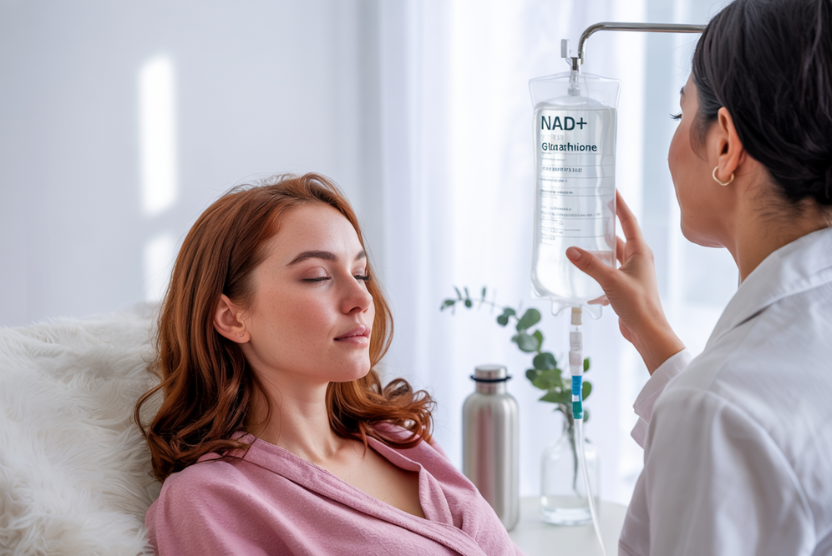
What to Expect During an NAD+ or Glutathione IV Session
Before the Infusion
History, medicines, allergies, vital signs, hydration status, pregnancy considerations, previous infusion reactions, and the intended product should be reviewed.
IV Placement
A trained clinician places a peripheral catheter using aseptic technique. Pain, swelling, burning, or leakage around the site should be reported immediately.
During NAD+ Infusion
NAD+ is often infused slowly because rapid administration may be associated with nausea, chest pressure or tightness, abdominal cramping, flushing, dizziness, headache, or fatigue. The appropriate response is clinical assessment, not automatically assuming every symptom is harmless.
Glutathione Administration
Timing, route, concentration, and sequence vary. It should not be mixed with NAD+ or another substance unless compatibility and stability have been verified.
Observation and Discharge
Vital signs and symptoms may be reassessed. Patients should receive written contact instructions and avoid driving when dizzy, faint, sedated, or otherwise impaired.
Session length is protocol dependent A universal two-to-four-hour treatment time cannot be promised. The ingredient, dose, concentration, infusion rate, tolerance, number of substances, and clinical setting affect duration.
Side Effects and Complications
NAD+ Infusion Symptoms
Nausea, abdominal discomfort or cramping, chest pressure or tightness, flushing, dizziness, headache, chills, shaking, vomiting, and fatigue have been reported with injectable NAD+ products or commercial infusions.
Glutathione Reactions
Nausea, vomiting, lightheadedness, chills, fever, shaking, low blood pressure, breathing symptoms, and allergic reactions can occur, especially when compounded product quality is compromised.
IV-Line Complications
Pain, bruising, infiltration, extravasation, phlebitis, bleeding, infection, nerve irritation, and rare bloodstream infection are possible with any IV.
Fluid and Electrolyte Concerns
IV fluid may be inappropriate for some people with heart failure, kidney disease, severe hypertension, fluid restriction, or electrolyte disorders.
Diagnostic Delay
Treating fatigue or brain fog with repeated infusions can delay evaluation of anemia, sleep apnea, thyroid disease, diabetes, medication effects, depression, or neurologic illness.
Cost and Opportunity Cost
Elective wellness IVs are often self-pay. Repeated treatment can divert money and time from therapies with stronger evidence.
Slowing an infusion may help some rate-related symptoms—but does not diagnose them Chest symptoms, low blood pressure, breathing difficulty, severe pain, or neurologic symptoms require assessment rather than automatic continuation at a slower rate.
When to Seek Urgent or Emergency Care
Stop the infusion and seek urgent medical evaluation for:
- Trouble breathing, wheezing, throat tightness, facial or tongue swelling, widespread hives, or fainting
- Persistent chest pain or pressure, severe shortness of breath, irregular heartbeat, or loss of consciousness
- Severe chills, shaking, high fever, confusion, very low blood pressure, or concern for contaminated product or bloodstream infection
- Sudden weakness, speech difficulty, severe headache, seizure, or another acute neurologic symptom
- Severe IV-site pain, rapidly increasing swelling, pale or cool skin, blistering, or loss of sensation
A symptom occurring during an infusion should not automatically be labeled a “detox reaction.” That phrase can delay recognition of allergy, endotoxin exposure, infection, excessive infusion rate, cardiac symptoms, anxiety, or another medical problem.
Compounding, Sterility, and Product Quality
Commercial NAD+ and glutathione injections are often compounded rather than supplied as FDA-approved finished drugs for wellness indications. Compounded drugs can be medically appropriate in selected circumstances, but they do not undergo the same FDA premarket review for safety, effectiveness, manufacturing quality, and labeling as approved products.
Questions to Ask the Clinic
- What is the exact ingredient and established name?
- Is this an FDA-approved finished drug or a compounded preparation?
- Which state-licensed pharmacy or registered outsourcing facility supplied it?
- Was the bulk ingredient suitable for sterile pharmaceutical compounding?
- What testing was performed for identity, potency, sterility, and endotoxins?
- What is the lot number, storage requirement, and beyond-use date?
- Will substances be mixed, and what compatibility data support that mixture?
- How are adverse events documented and reported?
FDA has separately warned about injectable NAD+ and glutathione quality FDA has received adverse-event reports after NAD+ injectable drugs, including severe chills, shaking, vomiting, and fatigue consistent with excessive endotoxin exposure. It has also investigated glutathione injectable reactions and recalled or cited compounded injectable products for quality or manufacturing concerns.
Frequently Asked Questions
Can NAD+ and glutathione be used together?
They can be considered together under medical supervision, but strong human trials have not shown that the combination produces better clinical outcomes than either substance alone or other approaches.
Should NAD+ and glutathione be mixed in the same IV bag?
Not without verified compatibility, stability, concentration, pH, and sterility information. They can be administered during the same visit without being physically mixed.
Does NAD+ IV provide 100% bioavailability?
IV delivery places the administered dose into systemic circulation, but that does not mean 100% enters target cells, remains intact, reaches a specific organ, or produces a clinical benefit.
Does NAD+ IV increase energy immediately?
No immediate or predictable energy benefit has been established. Some people report subjective changes, while others feel no benefit or experience nausea, pressure, cramping, headache, dizziness, or fatigue.
Does glutathione IV detox the liver or remove heavy metals?
Glutathione participates in normal liver-conjugation pathways, but elective IV glutathione has not been proven to perform a general toxin cleanse or replace evidence-based treatment for confirmed poisoning or heavy-metal exposure.
Is NAD+ or glutathione FDA-approved for anti-aging?
No FDA-approved wellness indication establishes NAD+ or glutathione IV as a treatment to reverse aging, extend lifespan, improve brain fog, or provide general detoxification.
Do NAD+ levels fall by exactly 50% with age?
Age-related decline has been reported, but the amount varies by tissue, health status, and measurement method. A universal 50% decline by a specific birthday should not be presented as an established personal fact.
Can oral NAD+ supplements work?
Most human research uses precursors such as nicotinamide riboside rather than direct oral NAD+. These products can raise NAD-related blood measures, but broad clinical benefits remain uncertain.
Can oral glutathione raise glutathione levels?
Yes, selected randomized studies and formulations have raised measured glutathione stores. That does not establish that oral or IV glutathione treats every symptom associated with oxidative stress.
How long do NAD+ and glutathione effects last?
There is no validated universal duration for subjective wellness effects. Claims that one session reliably improves energy or mental clarity for one to two weeks are based mainly on testimonials or commercial protocols.
How often should I receive NAD+ and glutathione IVs?
No evidence-based universal loading or maintenance schedule has been established for healthy-aging or wellness goals. Repeating treatment should depend on a defined goal, response, risk, cost, and clinician reassessment.
Why can NAD+ infusions cause chest tightness or nausea?
Symptoms can be associated with infusion rate, dose, product quality, anxiety, or another medical cause. The infusion should be paused and the patient assessed rather than assuming the reaction is always benign.
Can I use NAD+ or glutathione during cancer treatment?
Only with the oncology team’s approval. NAD metabolism and antioxidant pathways are involved in both normal and cancer cells, and supplementation may interact with selected treatments or research protocols.
Are compounded NAD+ and glutathione injections the same as FDA-approved drugs?
No. Compounded products do not undergo the same FDA premarket review for safety, effectiveness, manufacturing quality, and labeling as approved finished drugs.
Related Green Relief Health Guides
Medical References
- Cleveland Clinic. NAD (Nicotinamide Adenine Dinucleotide). Updated February 2026.
- Martens CR, et al. Chronic nicotinamide riboside supplementation is well-tolerated and elevates NAD+ in healthy middle-aged and older adults. Nature Communications. 2018.
- Reyna K, et al. Intravenous infusion of nicotinamide adenine dinucleotide and nicotinamide riboside: preliminary short-term safety and metabolic outcomes. 2026.
- Richie JP Jr, et al. Randomized controlled trial of oral glutathione supplementation on body stores of glutathione. European Journal of Nutrition. 2015.
- U.S. Food and Drug Administration. Concerns with using dietary-ingredient glutathione to compound sterile injectables.
- U.S. Food and Drug Administration. FDA reminds compounders to use ingredients suitable for sterile compounding. Includes NAD+ injectable adverse-event reports.
- Alangari A, et al. To IV or Not to IV: The Science Behind Intravenous Vitamin Therapy. 2025.
- Alzahrani TF, et al. Exploring the safety and efficacy of glutathione supplementation in adults. 2025.
Discuss the Evidence Before Starting an IV Protocol
Green Relief Health can review whether NAD+, glutathione, an oral option, laboratory evaluation, or another medical approach fits your situation.
Book Your Appointment Green Relief Health · Call (410) 368-0420
Medical disclaimer: This article provides general education and does not diagnose a condition, prescribe an infusion, or establish that NAD+ or glutathione will improve an individual’s symptoms. Human evidence for elective NAD+ IV, glutathione IV, and their combination remains limited. Compounded sterile products carry sourcing and quality considerations. Seek urgent medical care for severe infusion reactions, breathing difficulty, chest pain, fainting, high fever, neurologic symptoms, or signs of infection.