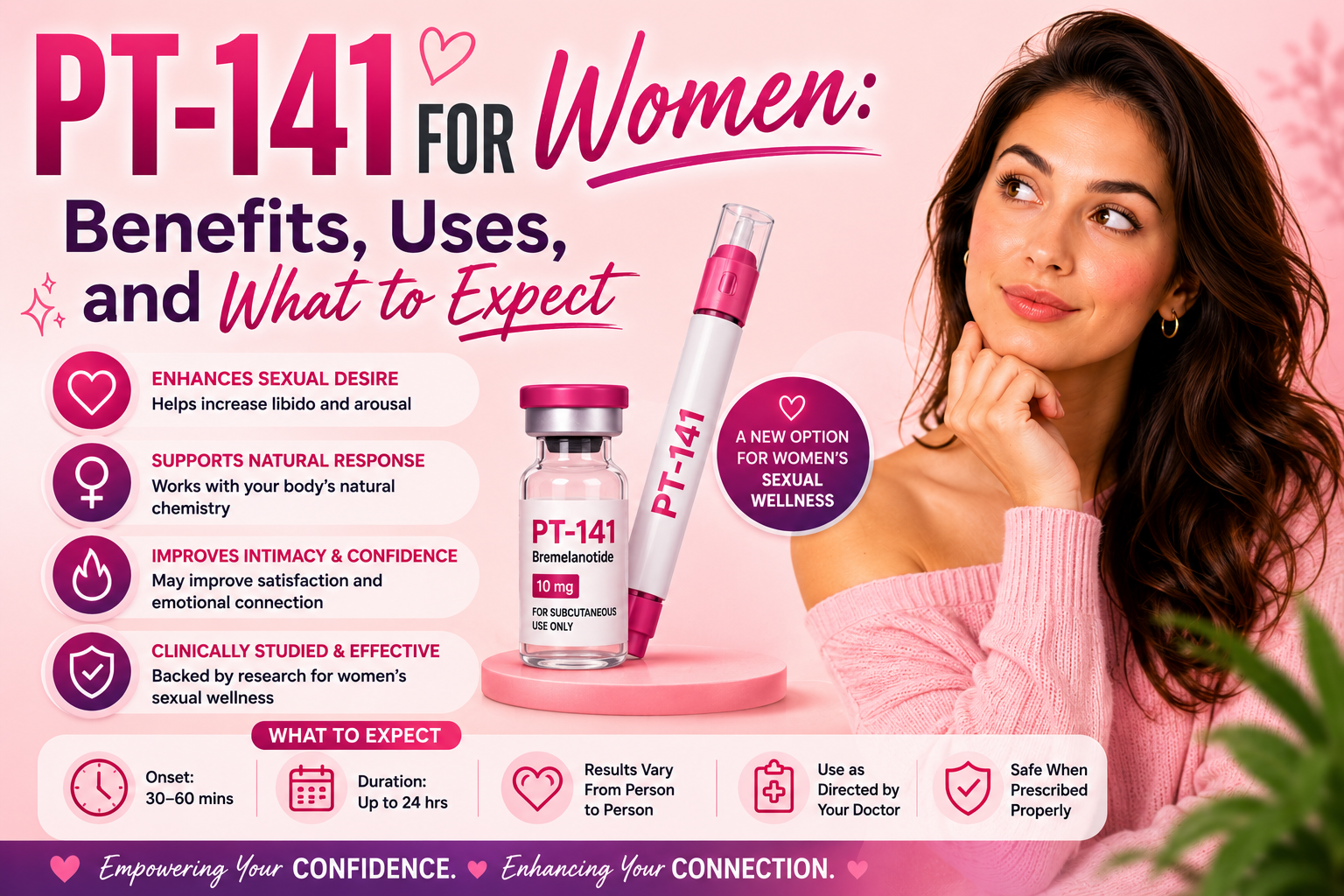
PT 141 for women is a synthetic peptide that treats hypoactive sexual desire disorder, or HSDD, in premenopausal women. The U.S. Food and Drug Administration approved this peptide in June 2019, highlighting its safety and efficacy, which can help women feel more confident in considering this treatment.
This treatment marked a turning point in female sexual health. It became the first centrally acting therapy cleared for HSDD. Two Phase 3 clinical trials, RECONNECT 1 and RECONNECT 2, enrolled more than 1,200 premenopausal women and demonstrated its effectiveness.
At Green Relief Health, women receive guidance on advanced peptide options through medically supervised programs. The sections below explain how PT 141 works, its benefits, its uses, and what every patient can expect.
2019
FDA approval year for PT 141 as Vyleesi
1.75 mg
Standard on-demand subcutaneous dose
45 min
Recommended timing before sexual activity
8/mo
Maximum monthly dosing frequency
Considering PT 141 for Low Desire?
HSDD needs a real evaluation. Hormones, medication side effects, mood, relationship factors, and cardiovascular safety all matter.
✨ What You’ll Learn
- PT 141 for Women: Quick Overview
- What Is PT 141 for Women?
- How PT 141 Works in the Female Body
- Key Benefits of PT 141 for Women
- Approved Uses of PT 141 for Women
- What to Expect During PT 141 Treatment
- Possible Side Effects and Safety Considerations
- Who Is a Good Candidate for PT 141?
- How PT 141 Compares to Other Sexual Health Treatments
- Final Thoughts on PT 141 for Women
PT 141 for Women: Quick Overview
Here is a quick overview of PT 141 for women before the deep dive.
| Attribute | Detail |
|---|---|
| Generic name | Bremelanotide |
| Brand name | Vyleesi |
| FDA approval year | 2019 |
| Approved use | HSDD in premenopausal women |
| Route | Subcutaneous injection |
| Standard dose | 1.75 mg per 0.3 mL |
| Onset | Within 45 minutes |
| Maximum frequency | 1 dose per 24 hours, 8 per month |
Bottom Line: PT 141 is not a hormone and not a blood-flow drug. It works centrally in the brain to support sexual desire pathways.
What Is PT 141 for Women?
PT 141 is a melanocortin receptor agonist that targets the MC3R and MC4R receptors in the central nervous system. These receptors regulate pathways for sexual motivation, arousal, and desire in the hypothalamus.
The peptide originated from a compound called Melanotan II. Scientists modified its structure to focus on sexual function rather than skin pigmentation. The FDA-approved version for women is sold as Vyleesi at a strength of 1.75 mg per 0.3 mL.
This medication is prescribed for acquired and generalized HSDD. Acquired means the condition developed later in life. Generalized means it occurs in all situations, not just with one partner or setting.
🧠 Key Definition
- Acquired: low desire developed later, rather than being lifelong.
- Generalized: low desire occurs across situations, not only with one partner or setting.
- Distressing: symptoms cause marked distress or interpersonal difficulty.
How PT 141 Works in the Female Body
PT 141 works through the brain rather than the bloodstream. Most sexual dysfunction treatments, such as sildenafil, rely on blood flow. PT 141 takes a different route by stimulating neural circuits that drive desire.
The peptide binds to melanocortin 4 receptors inside the hypothalamus. This binding releases dopamine in the medial preoptic area, a brain region linked to sexual motivation. The result is increased arousal at the source of desire.
Onset occurs within 45 minutes after a subcutaneous injection. The active effect lasts several hours. Because the mechanism is neurological, PT 141 helps women whose low desire stems from chemical signaling rather than hormonal imbalance.
For women whose low desire stems from hormonal imbalances, hormone therapy may be a complementary option, helping address underlying causes and providing a comprehensive treatment approach.
Practical Difference: If the main issue is desire signaling, PT 141 may make sense. If the issue is estrogen, testosterone, medication side effects, pain, or relationship distress, the answer may be different.
Key Benefits of PT 141 for Women
PT 141 for women delivers six measurable benefits backed by clinical evidence.
✅ Potential Benefits
- Increased sexual desire: RECONNECT trial data showed statistically significant gains on the Female Sexual Function Index desire domain.
- Reduced sexual distress: patients reported lower scores on the Female Sexual Distress Scale.
- On-demand use: the peptide is taken only when needed, about 45 minutes before sexual activity.
- Non-hormonal action: the peptide does not alter estrogen, progesterone, or testosterone levels.
- Brain-level treatment: PT 141 addresses the neurological pathway of desire, not just physical response.
- Proven safety profile: FDA approval followed Phase 3 trials involving over 1,200 premenopausal participants.
Clinical Trial Snapshot
| Clinical Measure | Trial Result |
|---|---|
| Combined trial enrollment | 1,247 premenopausal women |
| FSFI desire domain effect size | 0.49 to 0.61 |
| Improvement in sexual desire | Statistically significant vs placebo |
| Reduction in sexual distress | Statistically significant vs placebo |
| Trial duration | 24 weeks |
Important Context: PT 141 is not meant to create desire where distress, relationship conflict, medication effects, or untreated hormonal issues are the true drivers.
Approved Uses of PT 141 for Women
The FDA approved Vyleesi for one specific use in women. The indication is acquired and generalized hypoactive sexual desire disorder in premenopausal women.
The condition must cause marked distress or interpersonal difficulty. It must not be linked to another medical condition, psychiatric issue, relationship problem, or medication side effect.
HSDD affects roughly 1 in 10 adult women in the United States. Many women never receive a diagnosis because the topic remains underreported. PT 141 provides clinicians with a defined pharmacological option for a condition that previously had only one other approved treatment.
Approval Boundary
PT 141 is not approved for postmenopausal women. It is also not approved for women whose low desire stems from medication side effects, such as antidepressants.
What to Expect During PT 141 Treatment
Patients receive a clinical assessment before starting PT 141. The provider confirms the diagnosis of HSDD, reviews medical history, and screens for cardiovascular risk factors.
The peptide is delivered through a single-use autoinjector. The injection goes under the skin of the abdomen or thigh. Most women administer it themselves after training.
Dosing Rules
| Dosing Rule | Specification |
|---|---|
| Single dose strength | 1.75 mg subcutaneous |
| Timing before activity | At least 45 minutes |
| Maximum per 24 hours | 1 dose |
| Maximum per month | 8 doses |
| Evaluation period | 8 weeks |
Effects typically begin within an hour. Some women feel results sooner. The benefit fades after a few hours, which is why the dose is timed to the activity.
Clinical response is usually evaluated after 8 weeks of use. If desire and distress scores do not improve, the provider may recommend a different approach. Many women combine PT 141 with broader wellness care, including a Women’s Health Panel for comprehensive evaluation.
Use It Correctly: More frequent dosing is not better. It increases risk without making the treatment more appropriate.
Possible Side Effects and Safety Considerations
The most common side effect of PT 141 is nausea. The reaction usually decreases after one or two injections. Anti-nausea medication is sometimes prescribed alongside.
Other reported side effects include flushing, headache, injection site reactions, and temporary increases in blood pressure.
| Side Effect | Frequency |
|---|---|
| Nausea | About 40% of users after the first dose |
| Flushing | Around 20% |
| Injection site reactions | Around 13% |
| Headache | Around 11% |
| Vomiting | Around 5% |
| Focal hyperpigmentation | About 1% |
PT 141 is not safe for women with uncontrolled hypertension or known cardiovascular disease. The peptide can raise systolic blood pressure by about 6 mmHg and diastolic by about 3 mmHg for a few hours after the dose.
🚫 Do Not Use Casually
Women should avoid taking more than one dose in 24 hours and more than eight doses in a month. Pregnancy and breastfeeding are contraindications. Alcohol can worsen side effects and is not recommended around dosing time.
Who Is a Good Candidate for PT 141?
The ideal candidate for PT 141 is a premenopausal woman with acquired and generalized HSDD that causes distress. She has no uncontrolled cardiovascular conditions and no history of severe nausea or hypersensitivity to the medication.
✅ Candidate Criteria
- Premenopausal status confirmed by clinical evaluation.
- Documented HSDD with measurable distress.
- No alternative cause, such as medication, depression, or relationship issues.
- Stable blood pressure and no major heart disease.
- Willingness to use on-demand injection therapy.
Women who do not meet these criteria can still benefit from broader medical wellness care. Peptide therapy can cover a range of options for energy, recovery, and metabolic health, depending on the clinical situation.
Find Out If PT 141 Fits Your Health Profile
A confidential evaluation can clarify whether low desire is neurological, hormonal, medication-related, relational, or something else entirely.
How PT 141 Compares to Other Sexual Health Treatments
PT 141 differs from traditional sexual health medications in three ways. The mechanism is central, not peripheral. The timing is on-demand, not daily. The action is non-hormonal.
| Feature | PT 141 (Vyleesi) | Flibanserin (Addyi) | Sildenafil |
|---|---|---|---|
| FDA approval | 2019 | 2015 | 1998 |
| Approved for women | Yes, premenopausal HSDD | Yes, premenopausal HSDD | No |
| Mechanism | Central, MC4R | Central, serotonin | Peripheral, blood flow |
| Dosing schedule | On demand | Daily | On demand |
| Hormonal action | None | None | None |
| Alcohol restriction | Limited | Strict avoidance | Limited |
Different Tools, Different Problems
Do not compare sexual health treatments as if they all do the same thing. Desire, arousal, blood flow, pain, hormones, and distress are different clinical targets.
Final Thoughts on PT 141 for Women
PT 141 for women is the first, and only FDA-approved, centrally acting treatment for hypoactive sexual desire disorder in premenopausal patients. It works through brain pathways, not hormones or blood flow. The standard dose is 1.75 mg subcutaneously, taken 45 minutes before activity, with a limit of 1 dose per 24 hours and 8 per month.
The peptide offers a clinically validated tool for women whose low desire affects daily life. Side effects exist but are usually mild and manageable. Medical supervision is essential because PT 141 requires accurate dosing and close monitoring of blood pressure.
Women who want to know if PT 141 fits their personal health profile can schedule an evaluation with Green Relief Health. The team also offers weight-loss peptides and other peptide therapies that pair well with broader wellness goals.
Start a Confidential Consultation
Learn whether PT 141 can support your sexual wellness journey, or whether another medical, hormonal, or wellness pathway makes more sense.
📍 7690 Belair Road, Suite 1, Baltimore, MD 21236 | 📞 410-368-0420
Medical Disclaimer
This article is for informational purposes only and does not constitute medical advice. Consult a licensed healthcare provider before starting any peptide, medication, or sexual wellness protocol.
↑