Zepbound injection sites matter because the medication is designed to be injected under the skin, not into a muscle or vein. Knowing where to inject, how to rotate sites, and which reactions need medical attention can make treatment feel safer and more consistent.
Zepbound is the brand name for tirzepatide when prescribed for chronic weight management and for qualifying adults with obesity and moderate to severe obstructive sleep apnea.
It is taken once weekly and acts on two hormone pathways: GIP and GLP-1. These pathways help regulate appetite, fullness, blood sugar, and digestion.
Because many patients self-inject Zepbound, learning the approved injection areas and proper site-selection habits is an important part of treatment.
3
Approved general injection areas: abdomen, thigh, and back of the upper arm
2 Inches
Minimum distance to keep between an abdominal injection and the belly button
Weekly
Zepbound is administered once each week
Rotate
Use a different injection spot with each weekly dose
Starting Zepbound and Need Injection Guidance?
Review injection sites, dosing expectations, side effects, and your medically supervised treatment plan with Green Relief Health.
What Are Zepbound Injection Sites?
Zepbound injection sites are the approved areas where the medication can be injected into the fatty tissue just under the skin.
This type of injection is called a subcutaneous injection. Zepbound should not be injected into a muscle or vein.
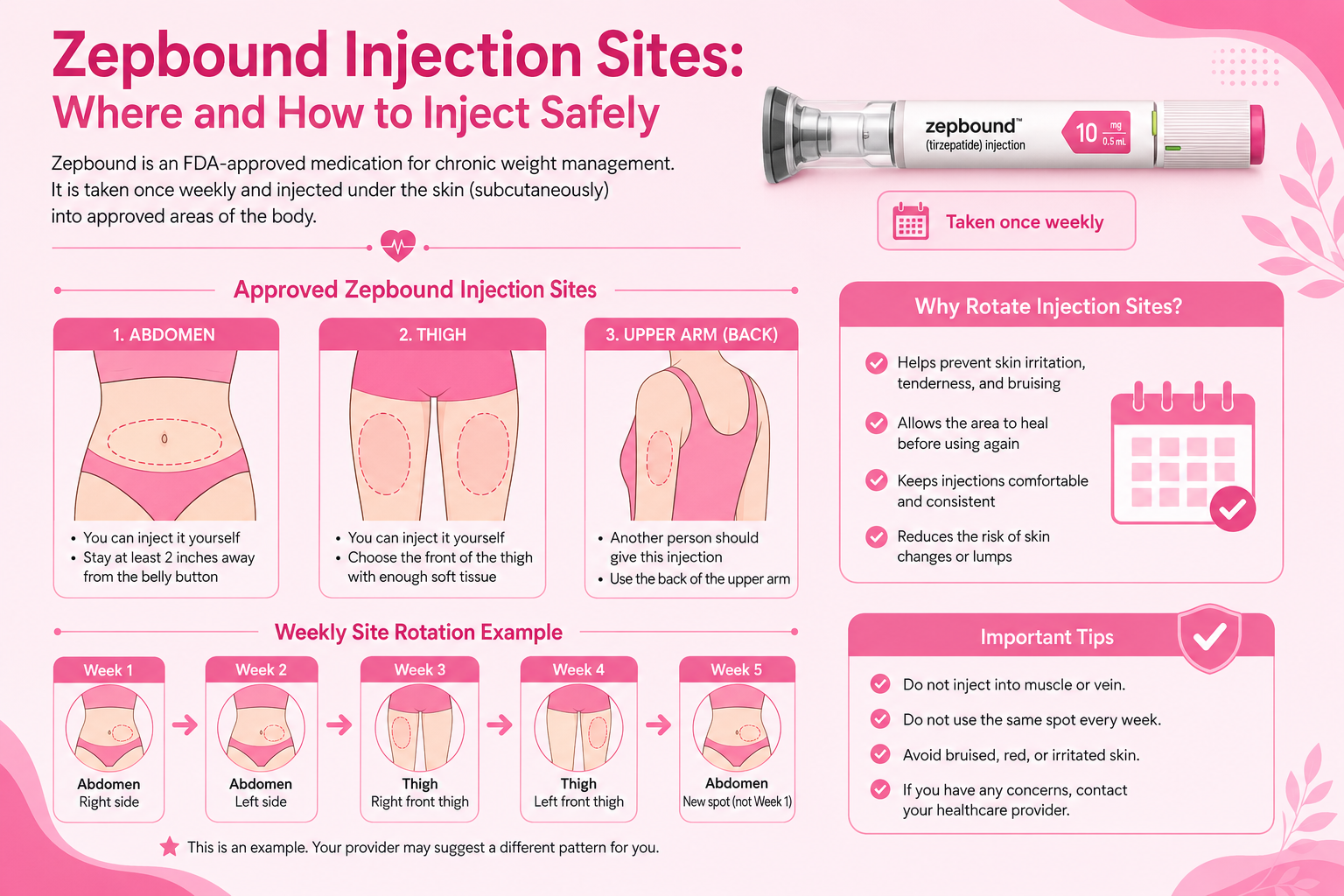
The approved general areas are the abdomen, front of the thigh, and back of the upper arm. Injection spots should be rotated to help reduce irritation, tenderness, bruising, and other local skin reactions.
Under the Skin
Zepbound is injected into the fatty layer beneath the skin rather than into muscle tissue.
Approved Areas
The approved areas are the abdomen, front of the thigh, and back of the upper arm.
Site Rotation
Patients should use a different spot with each dose rather than repeatedly injecting the same location.
Upper-Arm Help
Another person should administer an injection into the back of the upper arm.
The main safety rule: Inject Zepbound under the skin in an approved area and rotate the injection spot with each weekly dose.
Approved Zepbound Injection Sites
| Injection Site | Can You Inject It Yourself? | Important Notes |
|---|---|---|
| Abdomen | Yes | Stay at least 2 inches away from the belly button. |
| Front of Thigh | Yes | Choose an area with enough soft tissue and avoid sore or irritated skin. |
| Back of Upper Arm | Another person should inject | The area can be difficult to reach and stabilize correctly without help. |
| Same Exact Spot Every Week | No | Rotate to a different spot with each dose. |
| Bruised or Irritated Skin | No | Choose clean, healthy skin without redness, pain, or tenderness. |
Not Every Soft Area Is an Approved Injection Site
Zepbound should be injected only into the approved areas described in the product instructions and by the prescribing clinician.
Comparing the Abdomen, Thigh, and Upper Arm
Abdomen Injection Site
The abdomen is often an easy option because it is visible and accessible. The injection should be given at least 2 inches away from the belly button.
The abdomen also provides room for rotation. A patient may use the right side one week and the left side the next week while still choosing a new spot each time.
Avoid scars, raised stretch marks, bruising, redness, tenderness, or other irritated areas.
Thigh Injection Site
The front of the thigh is another approved area that many patients can inject themselves. Choose a location with enough soft tissue.
Avoid injecting too close to the knee, groin, or any area that feels hard, sore, bruised, or irritated.
Some patients prefer the thigh because it feels stable while sitting. Others prefer the abdomen because it offers more room for rotation.
Upper Arm Injection Site
The back of the upper arm is approved, but another person should administer the injection there.
This area can be difficult to reach while keeping the injection device properly positioned and steady.
Do not inject into the shoulder muscle. The medication is intended for the fatty tissue under the skin.
| Site | May Be Best For | Possible Drawback | Practical Tip |
|---|---|---|---|
| Abdomen | Easy self-injection and flexible site rotation | Some patients feel more sensitive there | Stay at least 2 inches away from the belly button |
| Thigh | Patients who prefer sitting during the injection | The area may feel sore when the leg is tense | Relax the leg before injecting |
| Upper Arm | Patients who have help from another person | Difficult to inject correctly alone | Use only the back of the upper arm |
| Rotating Within One Area | Patients who prefer a consistent routine | The same exact spot must still be avoided | Move to a nearby but different spot each week |
There Is No Single Best Site for Everyone
The best injection site is an approved area that the patient can use correctly, comfortably, and consistently while following rotation guidance.
Why Site Rotation Matters
Rotating Zepbound injection sites means choosing a different spot each week. Patients may use the same general area, such as the abdomen, but should avoid using the same exact location repeatedly.
Rotation gives the skin time to recover and may reduce irritation, tenderness, bruising, and skin changes.
Week 1: Right Abdomen
Choose healthy skin at least 2 inches away from the belly button.
Week 2: Left Abdomen
Select a new location rather than mirroring the exact previous spot.
Week 3: Right Front Thigh
Use an area with enough soft tissue and no bruising, redness, or tenderness.
Week 4: Left Front Thigh
Keep the leg relaxed and choose a healthy spot away from the knee and groin.
Week 5: Return to the Abdomen
Choose a new spot rather than reusing the original Week 1 location.
Keep Rotation Simple
A consistent pattern can make injection days easier to remember. The purpose is to protect the skin, not to create a complicated routine.
This Rotation Pattern Is Only an Example
A medical provider may recommend a different pattern based on the patient’s body, comfort, skin condition, or injection training.
Weekly Injection Timing and Dosing
Zepbound is injected once weekly. It can be taken at any time of day, with or without food, as long as it is taken on the same day each week.
The usual starting dose is 2.5 mg once weekly for four weeks. The dose typically then increases to 5 mg once weekly.
Later increases may occur in 2.5 mg steps after at least four weeks on the current dose when additional response is needed and the medication is tolerated.
| Treatment Stage | Dose | Usual Timing | Purpose |
|---|---|---|---|
| Starting Phase | 2.5 mg once weekly | First 4 weeks | Helps the body adjust |
| First Treatment Dose | 5 mg once weekly | After week 4 | Begins the main treatment phase |
| Optional Increase | 7.5 mg once weekly | After at least 4 weeks at 5 mg | May improve treatment response |
| Maintenance Option | 10 mg once weekly | As prescribed | May serve as a higher long-term dose |
| Optional Increase | 12.5 mg once weekly | After at least 4 weeks at 10 mg | Serves as a step before the maximum dose |
| Maximum Dose | 15 mg once weekly | As prescribed | Highest approved weekly dose |
Do Not Change the Dose or Schedule on Your Own
Dose increases and injection-timing changes should be made only with medical guidance based on treatment response, safety, and tolerability.
What to Check Before Injecting
Before each injection, choose clean, healthy skin and inspect the medication according to the product instructions.
Pre-Injection Checklist
- Wash your hands before handling the injection device.
- Choose an approved injection area with healthy skin.
- Avoid skin that is bruised, red, hard, scaly, painful, tender, or scarred.
- Do not inject through clothing.
- Clean the site if instructed and allow the skin to dry.
- Inspect the medication according to the product instructions before use.
- Ask a pharmacist or provider before using medication that appears cloudy, discolored, frozen, or contains particles.
| Skin or Site Condition | Inject There? | Why |
|---|---|---|
| Clean, Healthy Skin | Yes | This is the preferred option for a comfortable injection. |
| Bruised Skin | No | It may increase discomfort or worsen bruising. |
| Red or Irritated Skin | No | The injection may worsen local irritation. |
| Scarred Tissue | Avoid if possible | It may affect comfort and medication absorption. |
| Same Spot as Last Week | No | Rotation helps reduce repeated local reactions. |
| Abdomen Near the Belly Button | No | Stay at least 2 inches away. |
Common Zepbound Injection Site Reactions
Some patients notice mild redness, itching, tenderness, swelling, bruising, or a small bump after an injection. Local reactions can occur with many injectable medications.
Injection site reactions are listed among adverse reactions reported with Zepbound. Most mild local reactions are not emergencies.
The reaction should generally improve rather than spread, become hotter, or grow more painful.
| Reaction | May Be Mild | Contact a Provider When |
|---|---|---|
| Small Bruise | Often | It becomes large, severe, or occurs repeatedly |
| Mild Redness | Often | It spreads, becomes hot, or worsens |
| Itching | Often | It occurs with widespread rash or swelling |
| Small Bump | Often | It grows, becomes painful, or does not improve |
| Localized Tenderness | Sometimes | The area becomes increasingly painful or inflamed |
Repeated Reactions May Signal a Technique Issue
If local reactions happen frequently, ask a medical provider to review injection technique, site choice, and the rotation pattern.
When to Seek Help for an Injection Reaction
Some injection-related symptoms need prompt medical attention. A severe allergic reaction requires emergency care.
Seek Emergency Care
Call for urgent help if you experience difficulty breathing, swelling of the face or throat, widespread hives, severe dizziness, or other signs of a serious allergic reaction after the injection.
Contact a Medical Provider Promptly
Seek medical guidance if redness spreads, swelling worsens, pus appears, or the injection area becomes hot, increasingly painful, or unusually large.
A mild local spot should improve, not expand or worsen. It is better to ask for medical guidance early when an injection reaction feels unusual.
Common Mistakes With Zepbound Injection Sites
→ Using the same exact spot every week. Repeatedly injecting one location may increase irritation, bruising, tenderness, and skin changes.
→ Injecting too close to the belly button. Abdominal injections should remain at least 2 inches away.
→ Self-injecting into the back of the upper arm. Another person should administer injections into this area.
→ Injecting into irritated or damaged skin. Choose a nearby approved area with clean, healthy skin instead.
→ Injecting into the shoulder muscle. Zepbound is intended for the fatty tissue under the skin, not muscle tissue.
→ Changing the dose or timing without guidance. Injection-site decisions and medication-dosing decisions should both follow the treatment plan.
Small Technique Errors Can Affect Comfort
Even when the medication and dose are correct, poor site selection or repeated use of one spot may make injections more uncomfortable.
Do Injection Sites Affect Digestive Side Effects?
The injection site may affect local comfort, but most digestive side effects occur because of how tirzepatide works throughout the body.
Nausea, diarrhea, constipation, vomiting, reflux, burping, and appetite changes are not usually caused by choosing the abdomen instead of the thigh.
These effects are connected to appetite regulation and slower stomach emptying.
| Symptom Type | Usually Related To |
|---|---|
| Redness, Bruising, or Tenderness | The local injection site, technique, or repeated use of one spot |
| Nausea or Reduced Appetite | Tirzepatide’s effects on appetite and stomach emptying |
| Constipation or Diarrhea | Digestive adjustment, food intake, hydration, and medication effects |
| Reflux or Burping | Slower stomach emptying and meal-related factors |
Changing Sites May Not Resolve Systemic Side Effects
Persistent or severe digestive symptoms should be discussed with a medical provider rather than managed only by switching injection areas.
Zepbound and Weight-Loss Support
Zepbound works best as part of a complete weight-management plan. The medication may reduce appetite, but nutrition, hydration, protein, movement, sleep, and follow-up care still matter.
Protein
Protein intake may help support muscle during weight loss.
Hydration
Adequate fluids may help reduce constipation, dizziness, and dehydration risk.
Movement
Strength training and regular activity may help protect lean mass and support long-term health.
Sleep
Consistent sleep can support appetite regulation, energy, and treatment adherence.
Medical Follow-Up
Ongoing monitoring can help address side effects, dosing, and changes in health status.
Consistent Technique
Correct injection habits can make weekly treatment more comfortable and predictable.
Some Patients Need Closer Monitoring
Medical supervision is especially important for patients with diabetes, kidney concerns, gallbladder issues, reflux, severe digestive symptoms, or multiple medications.
Get Support With Zepbound Injection and Treatment Planning
Review injection technique, site rotation, dosing, side effects, nutrition, and long-term weight-management support.
Final Thoughts
Zepbound injection sites include the abdomen, front of the thigh, and back of the upper arm.
The abdomen and thigh can generally be self-injected, while another person should administer an injection into the back of the upper arm.
The medication should be injected under the skin, and the injection spot should be rotated with each weekly dose. Avoid bruised, red, irritated, hard, painful, tender, or scarred skin.
Mild local reactions can happen, but spreading redness, severe swelling, pus, increasing heat, significant pain, or allergic symptoms should be evaluated promptly.
Safe injection habits can make treatment more comfortable, consistent, and easier to maintain over time.
Start Zepbound With Clear, Medically Guided Expectations
Green Relief Health can help you understand injection sites, dosing, possible side effects, and a treatment plan built around your goals and health history.
📍 7690 Belair Road, Suite 1, Baltimore, MD 21236 | 📞 410-368-0420
Frequently Asked Questions
Where can Zepbound be injected?
Zepbound can be injected under the skin in the abdomen, front of the thigh, or back of the upper arm. Another person should administer an injection into the back of the upper arm.
How far should an abdominal injection be from the belly button?
Choose an abdominal injection spot at least 2 inches away from the belly button and avoid bruised, red, tender, scarred, or irritated skin.
Can I use the same Zepbound injection spot every week?
No. The injection spot should be rotated with each weekly dose. You may use the same general area, but choose a different location to help reduce irritation and give the skin time to recover.
Can I inject Zepbound into my upper arm by myself?
Another person should administer an injection into the back of the upper arm because the area can be difficult to reach and stabilize correctly on your own.
What injection site reactions are usually mild?
A small bruise, mild redness, localized itching, tenderness, swelling, or a small bump may be mild. Contact a provider if the reaction spreads, becomes hot or increasingly painful, produces pus, or does not improve.
Does the injection site cause nausea or constipation?
Most digestive symptoms are related to tirzepatide’s effects on appetite and stomach emptying rather than whether the medication was injected into the abdomen or thigh.
Medical Disclaimer
This article is for informational purposes only and is not medical advice. It does not replace the Zepbound product instructions, injection training, or individualized guidance from a qualified healthcare professional. Always consult your prescribing clinician before starting, stopping, changing, or restarting medication or altering your dose, schedule, or injection technique. Seek emergency care for difficulty breathing, swelling of the face or throat, widespread hives, severe dizziness, or other signs of a serious allergic reaction.
↑